Machine foundations fail for a predictable reason: whatever fills the gap between the baseplate
and the concrete cannot handle the load concentrated on it. Concrete cracks. Weaker grouts
shear. The equipment loses alignment, and the plant loses uptime. Unisorb’s V-100 Epoxy
Grout exists to solve that specific problem.
What is V-100 Epoxy Grout?
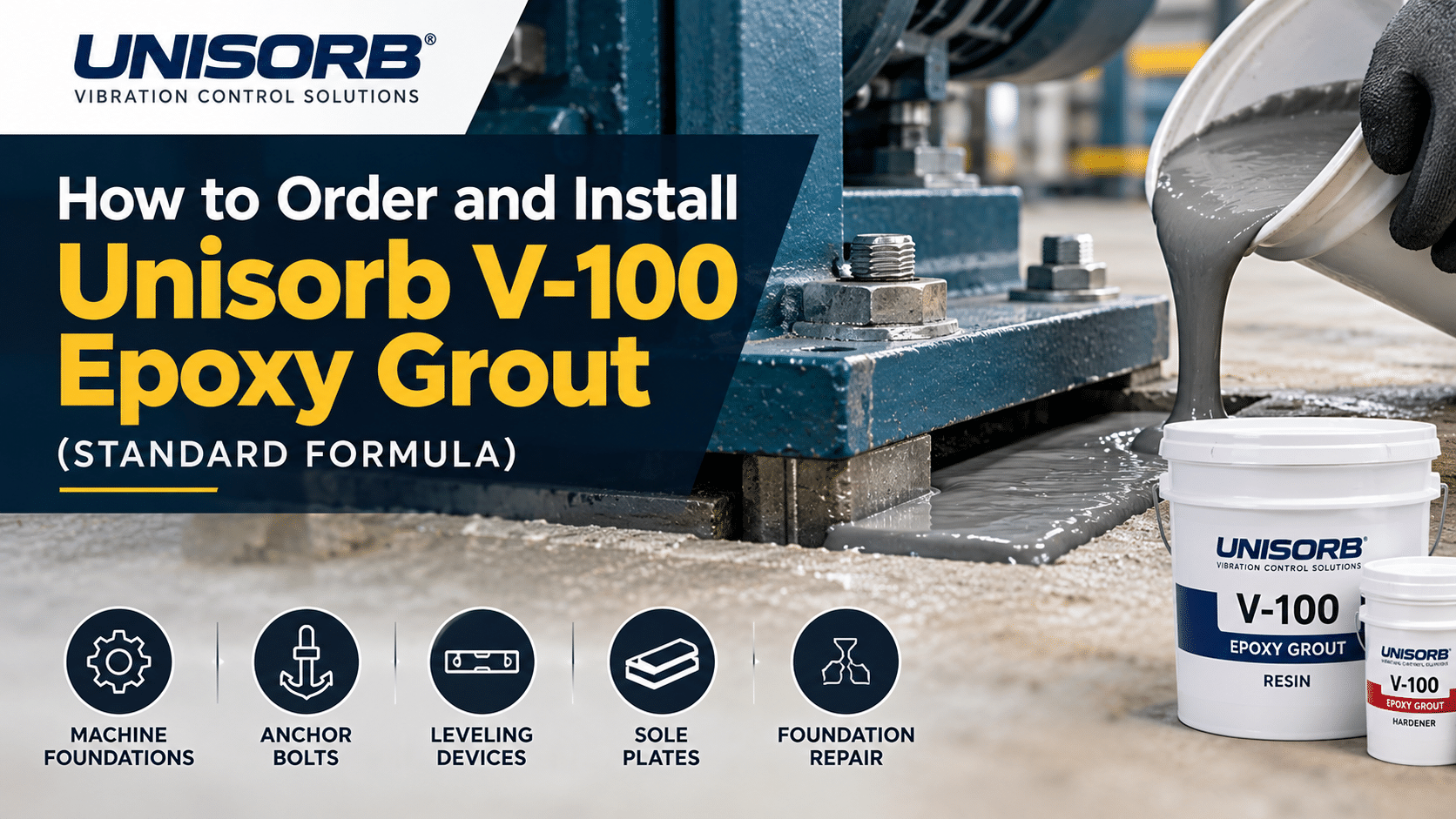
Standard V-100 is a two-part epoxy grout: a resin and a hardener that get mixed together on-
site. Once combined, the mixture flows into the gap between a machine’s baseplate and the
concrete floor beneath it, then cures into a hard, stable base that keeps the equipment level and
aligned.
It’s rated 100% solids, meaning nothing evaporates as it cures. That means no shrinkage and
none of the fumes associated with volatile organic compounds (VOCs), which are common in
lower-quality grouting products. Standard V-100 is also free of two other ingredients often
flagged in weaker products for health or environmental concerns: butyl glycidyl ether (BGE) and
nonylphenol.
Once cured, it’s roughly 5 times stronger under compression than concrete, and at least 15
times stronger when it comes to bending or pulling forces. In practical terms, that means it holds
up under the heavy, concentrated loads that would crack plain concrete or shear a weaker grout
over time. Full physical property data is available in Unisorb’s technical bulletin (GB-0198-1.1,
Rev. 3).
Typical applications include:
- Grouting machine bases
- Setting anchor bolts
- Installing Fixators and other leveling devices
- Placing sole plates
- Repairing deteriorated foundations
Standard V-100 is designed for clearances of ½ inch to 1½ inches, both vertically and laterally.
For gaps outside that range, or for any application-specific question, Wilrep recommends
consulting with Unisorb’s engineering team before ordering.
Ordering
Standard V-100 ships in 3 kit sizes:
| Kit Size | Yield |
| 11 lb. kit | 0.10 cu. ft. |
| 22 lb. kit | 0.21 cu. ft. |
| 55 lb. kit | 0.53 cu. ft. |
To estimate quantity, calculate the void volume under the equipment in cubic inches, then divide
by 16 — Standard V-100’s density works out to roughly 16 cubic inches per pound of mixed
grout. That figure gives a quick estimate of how many pounds to order; round up to the nearest
kit size, since the grout’s 15-minute working time makes it impractical to mix a second small
batch mid-pour if the first falls short. For anything beyond a straightforward fill, confirm the
calculation with Unisorb’s engineering team before ordering.
Installation
Surface Preparation
Concrete surfaces must be free of oil, grease, and contamination, with all loose or weak
concrete removed. The surface must be dry, with no standing water. Metal surfaces —
baseplates or soleplates — must be clean and free of rust, dirt, and other contaminants.
Forming
Forms need to allow rapid, continuous placement with adequate clearance and head room for
the grout. They should be watertight and greased or waxed for easy removal once the grout
cures.
Component Conditioning
Before mixing, store the resin, hardener, and aggregate in a dry, temperature-controlled space
between 75°F and 90°F (approx. 24°C to 32°C) until all 3 components reach that range.
Depending on the season, this can take 24 to 72 hours. Skipping this step affects mix
consistency and placement.
Mixing
Pre-mix the resin component first to fully incorporate its liquids and solids. Then pour the
hardener into the resin container and mix with a low-speed, high-power drill and paddle. It’s
recommended to mix at low-speed at an approx. 45-degree angle, while slowly pouring the
hardener into the vortex. Periodically scrape the sides and bottom of the container so no
unmixed resin remains. The grout is ready when the color is smooth and consistent, with no
dark blue or brown streaks. Do not add water.
Pouring
Pour immediately after mixing from one side only, to prevent air pockets from forming under the
equipment. Continue until the grout flows completely to the other side and reaches a depth
sufficient to eliminate voids. The material self-levels in most conditions, though in cold weather it
may need agitation or manual encouragement to flow fully under the equipment.
Placement and Cure Time
Placement time — how long the material stays workable — depends on air temperature,
foundation temperature, and grout temperature: cooler conditions extend the window, warmer
conditions shorten it. At 77°F (approx. 24°C), a ½ inch section cures to usable strength in 8
hours. Temperatures below 70°F or above 90°F (approx. 21°C to 32°C) require special
precautions; contact Unisorb for guidance in those conditions.
Cleanup
Clean tools and mixing equipment with a mild solvent, detergent, or pressurized water rinse
before the grout cures. Immediate cleanup gives the best results.
Regrouting
If soil or foundation settlement requires regrouting, break any rigid connections between the
existing grout and the equipment, raise the equipment to the correct elevation and alignment,
and regrout following the same procedure.
Safety
Wear appropriate personal protective equipment (PPE) throughout mixing and placement. Keep
the work area well ventilated and avoid inhaling fumes. Wash skin and clothing with soap and
water immediately if contact occurs, before the grout cures. Full safety data is available in the
product’s Safety Data Sheet (SDS).